
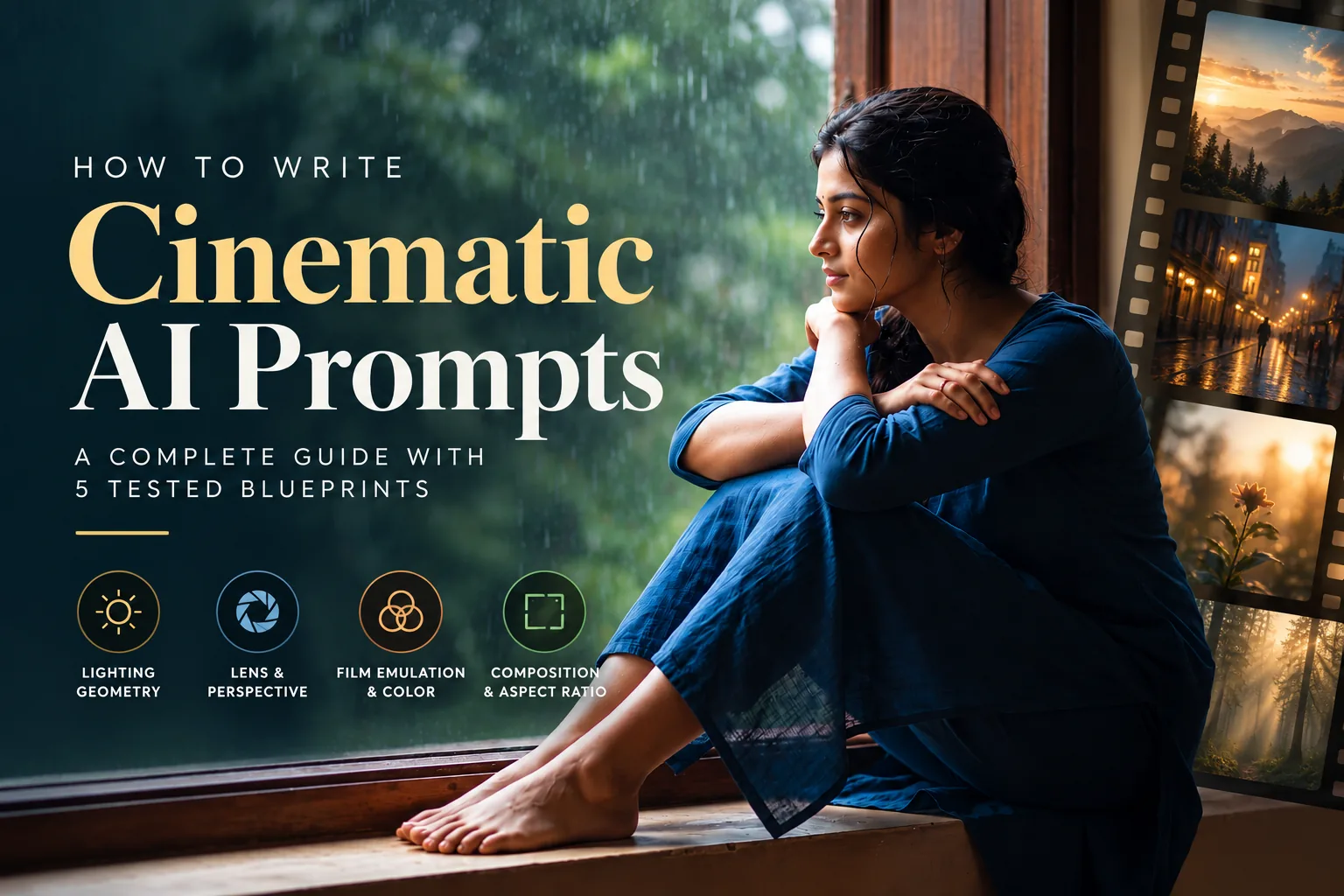
Creating authentic cinematic prompts rarely works by just typing the word “cinematic” into an image generator. More often, it triggers an aggressive digital preset: muddy brown shadows, over-saturated teal skies, and artificial lens flares splashed across the frame.
Real cinema does not come from a generic filter. It comes from disciplined cinematography: motivated light sources, deliberate optical choices, controlled depth of field, and balanced color grading.
Modern generative vision models across Google Gemini, ChatGPT, and Midjourney are trained on millions of authentic photographic and film frames. Whether you are generating a Gemini photo prompt or prompting Midjourney, replacing empty adjectives with real cinematography vocabulary allows the engine to accurately reconstruct natural depth cues, optical compression, and realistic lighting geometry.
This master guide breaks down the four technical pillars of cinematic AI prompts. It includes five tested blueprint prompts developed at South Prompts that you can adapt for portraits, landscapes, and storytelling scenes.
Why the Word “Cinematic” Fails in AI Prompts
When you prompt an image generator with a phrase like “cinematic portrait of a man,” the engine relies on statistical training bias to fill in the blanks. In modern vision models, the token “cinematic” maps heavily to blockbuster movie posters, extreme contrast, and aggressive digital color grades. Without specific camera and lighting constraints, the model defaults to predictable tropes: oversaturated teal-and-orange palettes, harsh artificial rim lights, and excessive sharpening.
Real cinema relies on deliberate optical craft rather than stylistic filters. To get authentic, filmic results, you must define four key photographic decisions:
- Light source and motivation: Specify where the key light originates, how soft the shadows fall, and how ambient bounce fills the scene.
- Focal length and perspective: Choose whether a 35mm lens preserves environmental context or an 85mm lens isolates the subject with gentle spatial compression.
- Aperture and focus falloff: Control background separation with concrete f-stop values rather than vague blur commands.
- Color timing and sensor response: Guide highlight roll-off, shadow retention, and subtle grain by referencing authentic film stocks and balanced color palettes.
Directing the frame like a cinematographer eliminates the engine’s guesswork. You bypass generic digital styling and produce frames with natural depth, balanced contrast, and believable realism.
The 4 Pillars of Cinematic Prompt Engineering
[1. Motivated Lighting Geometry]
       ↓
[2. Optical Physics & Lens Selection]
       ↓
[3. Film Emulation & Color Timing]
       ↓
[4. Aspect Ratio & Spatial Composition]
1. Motivated Lighting Geometry
In cinematography, every light source must have a clear physical origin within the scene. Instead of asking for generic “good lighting,” define the exact setup:
- Key light direction: Specify the primary light source, such as low-angle morning sunlight, an overcast north-facing window, or a diffused side softbox.
- Rim and edge light: Position a light source behind or beside the subject. Skimming light along hair, shoulders, or fabric creates natural subject separation without harsh digital outlines.
- Ambient fill and shadow density: Control contrast directly. Request “open shadow detail” for an airy editorial feel, or “steep, atmospheric shadow falloff” for dramatic low-key scenes.
- Practical in-scene sources: Introduce physical light fixtures like vintage desk lamps, neon storefronts, or candles. These give the engine real anchor points to cast believable light and reflections.
2. Lens Perspective and Depth of Field
Focal lengths dictate how space, background compression, and subject proportions translate onto the sensor:
- 35mm lens (environmental storytelling): Retains surrounding scenery while keeping perspective distortion controlled. Ideal for travel portraits, bustling interiors, and narrative street scenes.
- 50mm lens (natural human perspective): Matches standard human vision with neutral proportions and zero distortion. Perfect for waist-up portraits and candid lifestyle moments.
- 85mm to 105mm lens (cinematic compression): Compresses background elements, brings distant horizons closer, and isolates the subject against creamy background blur.
- Explicit f-stop values: Always combine focal length with an aperture setting like f/1.8, f/2.8, or f/5.6. Concrete aperture values produce authentic optical falloff instead of artificial post-process blur.
3. Film Emulation and Color Timing
Modern digital renders often look clinical or plastic. Authentic cinematic warmth relies on the analog response of photochemical film:
- Film stock references: Direct color grading and tonal curves by naming authentic film stocks. Use “Kodak Portra 400” for natural skin tones and warm highlights, “Fujifilm Provia” for clean greens and cool shadows, or “CineStill 800T” for tungsten halation around light sources.
- Highlight roll-off and dynamic range: Ask for “soft specular highlight roll-off” and “balanced dynamic range.” This keeps bright skies and illuminated skin from blowing out into harsh pure white.
- Drop legacy render tags: Remove outdated tokens like “unreal engine,” “octane render,” “hyperrealistic,” and “8k.” In modern vision engines, these prompt artifacts force heavy digital edge-sharpening and synthetic plastic skin.
4. Aspect Ratio and Spatial Framing
Square 1:1 frames restrict visual storytelling. Match professional cinematic and editorial aspect ratios to give your composition space to breathe:
- Vertical editorial (4:5 or 3:4): Delivers clean headroom and balanced torso framing without vertical stretching. Ideal for mobile feeds, digital magazines, and character portraits.
- Widescreen cinema (16:9): The universal standard for episodic and film stills. Provides ample room to balance your subject against vast environmental backdrops.
- Anamorphic scope (2.39:1): Emulates classic widescreen cinema. Perfect for sweeping landscape vistas, automotive highway tracking shots, and cinematic tension.
5 Master Blueprint Cinematic Prompts
These tested cinematic prompts demonstrate how to apply optical and lighting directions across diverse photographic genres. Copy and customize them in Gemini, ChatGPT, or Midjourney.
1. Atmospheric Golden Hour Heritage Courtyard Portrait
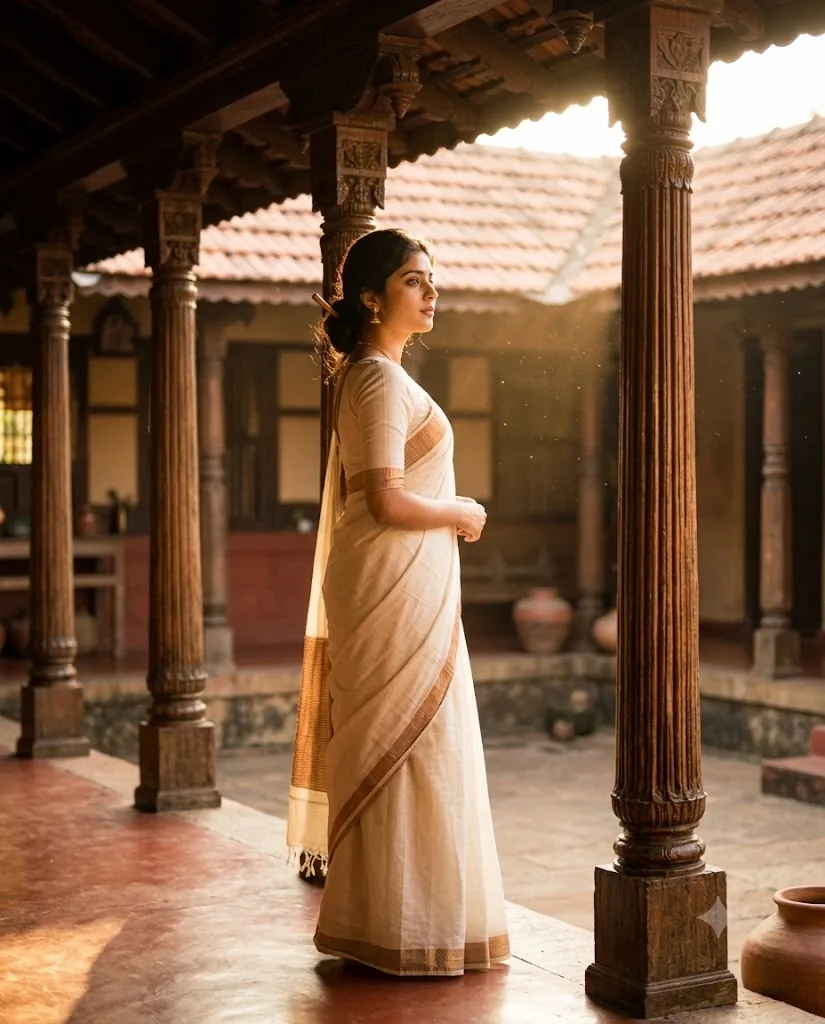
Best for: Traditional portraits, cultural storytelling, warm nostalgic visuals.
Prompt:
Generate a medium-wide portrait of a young South Asian woman standing beneath the wooden colonnade of an ancestral heritage home during sunset.

Subject & Styling: She wears an unbleached off-white handloom cotton saree with a subtle bronze zari border. Hair is loosely secured with a simple wooden hairpin. She looks toward the inner courtyard with a quiet, thoughtful gaze.

Lighting & Environment: Low-angle golden hour sunlight streams horizontally between carved teakwood pillars, illuminating airborne dust particles with warm amber sunbeams. The background shows red terracotta roof tiles and polished red oxide veranda floors reflecting soft ambient light.

Cinematography & Optics: Shot on an 85mm prime lens at f/2.0. Soft directional rim light outlines her hair and shoulder, separating her from the darker interior behind her. Creamy background falloff, visible cotton weave texture, natural skin tones, 35mm film warmth, aspect ratio 4:5.
- Why this Gemini photo prompt works: Specifying “low-angle horizontal sunlight” and “carved teakwood pillars” gives the engine physical surfaces to illuminate and cast shadows from. This makes it an ideal Gemini photo prompt or Midjourney setup because it relies on tangible spatial cues rather than vague filters. The 85mm f/2.0 instruction keeps focus sharp on the subject while melting the courtyard into soft background tones. See similar lighting setups in the South Prompts Cinematic Photography Collection.
2. Moody Mountain Pass Travel Portrait
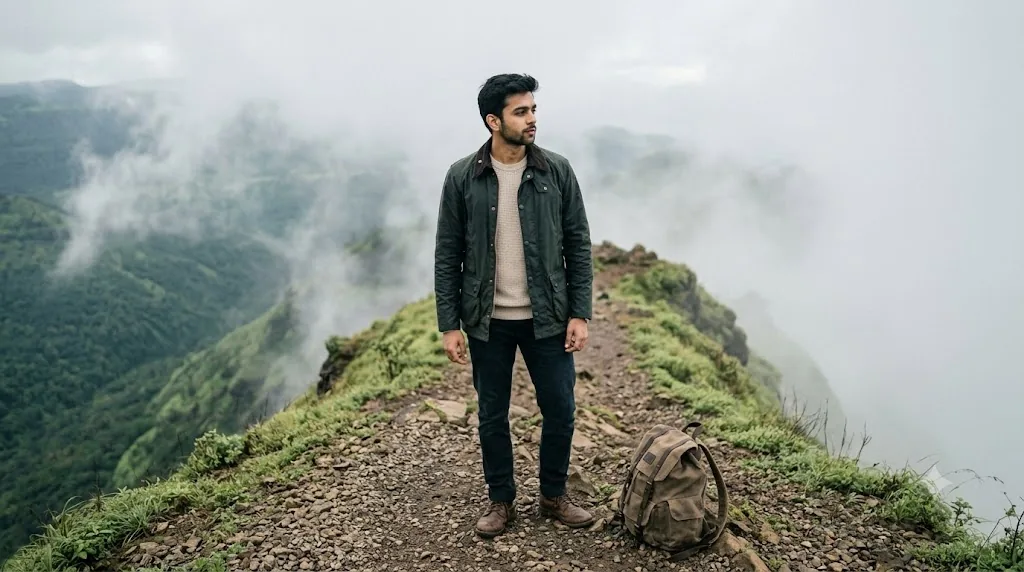
Best for: Adventure travel, outdoor apparel, highland landscapes.
Prompt:
Generate an environmental portrait of a young South Asian traveler standing on a narrow mountain ridge overlooking a misty valley in the Western Ghats.

Subject & Styling: Candid, relaxed posture. He wears a dark forest-green waxed canvas utility jacket over an oatmeal waffle-knit crewneck sweater, dark denim trousers, and worn leather boots. A canvas backpack rests on the gravel beside him.

Lighting & Environment: Dense morning fog drifts across deep emerald valleys below. Soft, overcast daylight filtered through cloud cover creates gentle, shadowless illumination across his face. Tiny moisture droplets glisten on the surface of his waxed jacket.

Cinematography & Optics: Shot on a 35mm prime lens at f/2.8 to capture both the subject and the vast landscape. Crisp foreground focus with a natural, atmospheric depth fade into the mist. Subdued, earthy color grading, subtle film grain, clean highlight retention, aspect ratio 16:9.
- Why this Gemini photo prompt works: A 35mm lens balances subject scale with landscape depth. In travel-focused cinematic prompts, specifying “waxed canvas” and “waffle-knit sweater” provides micro-textures that respond naturally to diffused mountain light.
3. Vintage Highway Motorcycle Still
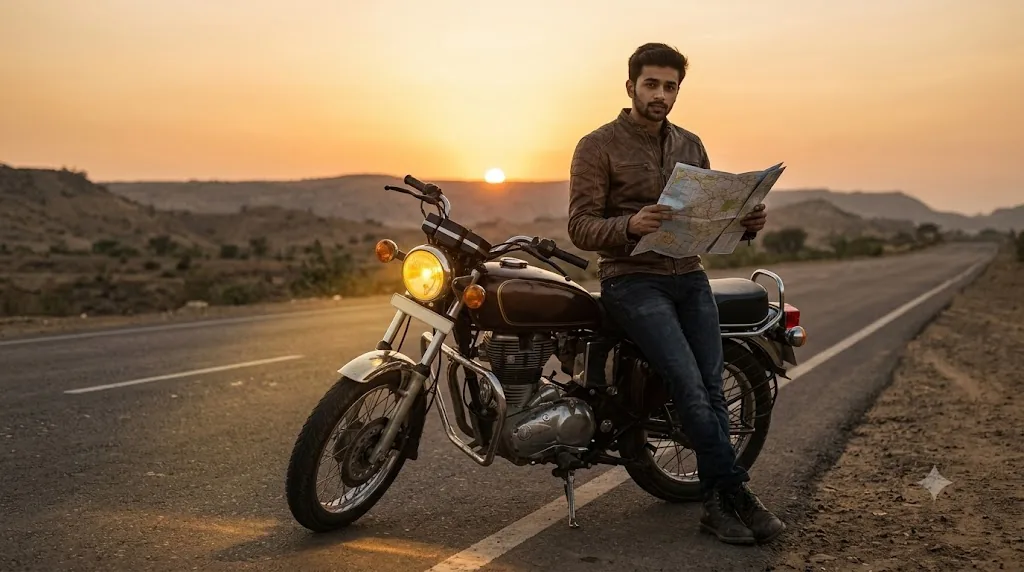
Best for: Automotive lifestyle, road trips, retro editorial spreads.
Prompt:
Generate a full-body shot of a vintage classic motorcycle parked along a dusty two-lane highway at dusk, with the rider standing beside it.

Subject & Styling: A young South Asian man in a distressed brown leather jacket, dark jeans, and boots leans comfortably against the rear seat, holding an open road map.

Lighting & Environment: The warm amber glow of a setting sun sits just above the distant horizon, casting long, dramatic shadows across the asphalt. The warm yellow headlight of the motorcycle is turned on, casting a gentle warm pool of light onto the road ahead.

Cinematography & Optics: Shot on a 50mm f/1.8 lens from a low camera angle. Warm golden flare skims the chrome engine fins and leather jacket surface. High dynamic range with preserved shadow textures, rich analog color timing, aspect ratio 16:9.
- Why this Gemini photo prompt works: The low camera angle creates a heroic, cinematic perspective. Adding the motorcycle headlight introduces a second, practical light source that balances the natural sunset backlight. Explore related concepts in South Prompts Bike Portraits.
4. Quiet Rain on the Veranda Still
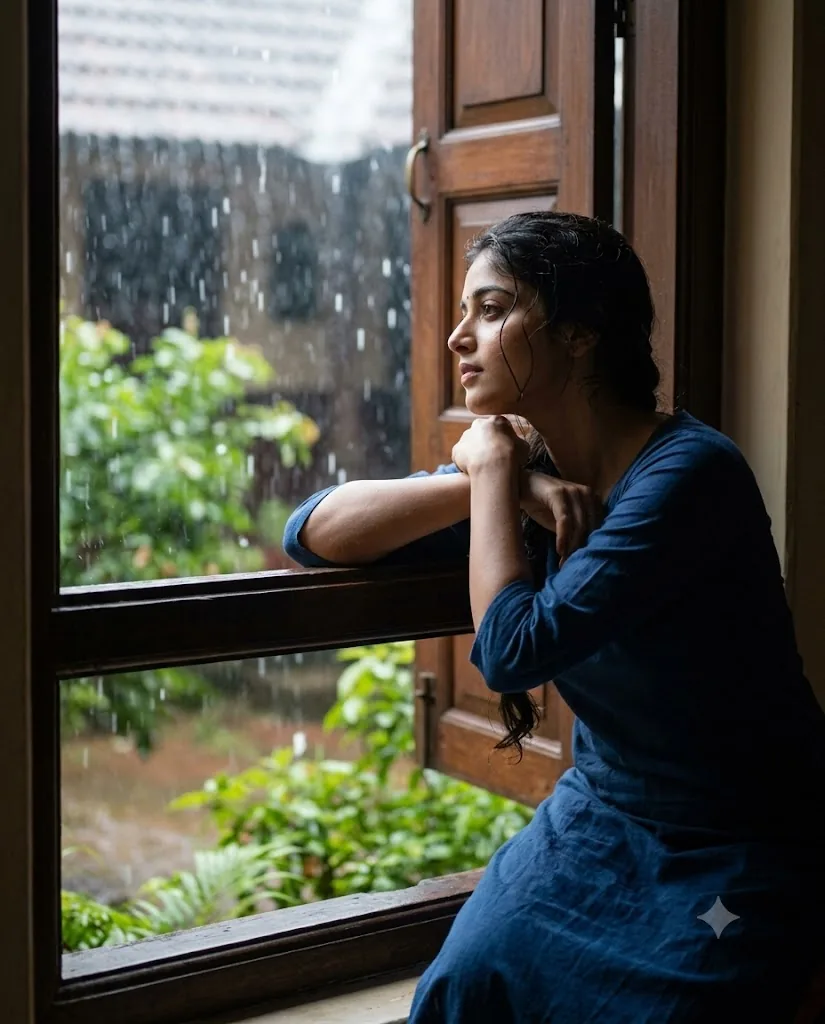
Best for: Emotional storytelling, rainy season aesthetics, intimate portraits.
Prompt:
Generate an intimate portrait of a woman looking out through an open heritage window during a heavy tropical rainstorm.

Subject & Styling: She sits sideways on a dark wood window sill, chin resting lightly on her folded arms. She wears a simple indigo cotton kurta. A few stray damp hairs cling softly to her cheek.

Lighting & Environment: Heavy monsoon rain falls outside the window in continuous soft streaks, splashing against green tropical foliage in the courtyard. Cool, diffused daylight enters through the window opening, gently sculpting her profile while the room interior fades into soft shadow.

Cinematography & Optics: Shot on an 85mm f/1.4 lens. Extremely shallow depth of field, turning falling raindrops into luminous streaks of soft bokeh. High tactile detail on skin pores and damp fabric, moody color palette dominated by indigo and slate, vertical aspect ratio 4:5.
- Why this Gemini photo prompt works: Raindrops rendered with an 85mm lens at f/1.4 create natural specular bokeh. Atmospheric cinematic prompts like this rely on cool daylight spill to create authentic interior-exterior contrast without artificial studio lights.
5. High-Fashion Studio Backlit Silk Editorial
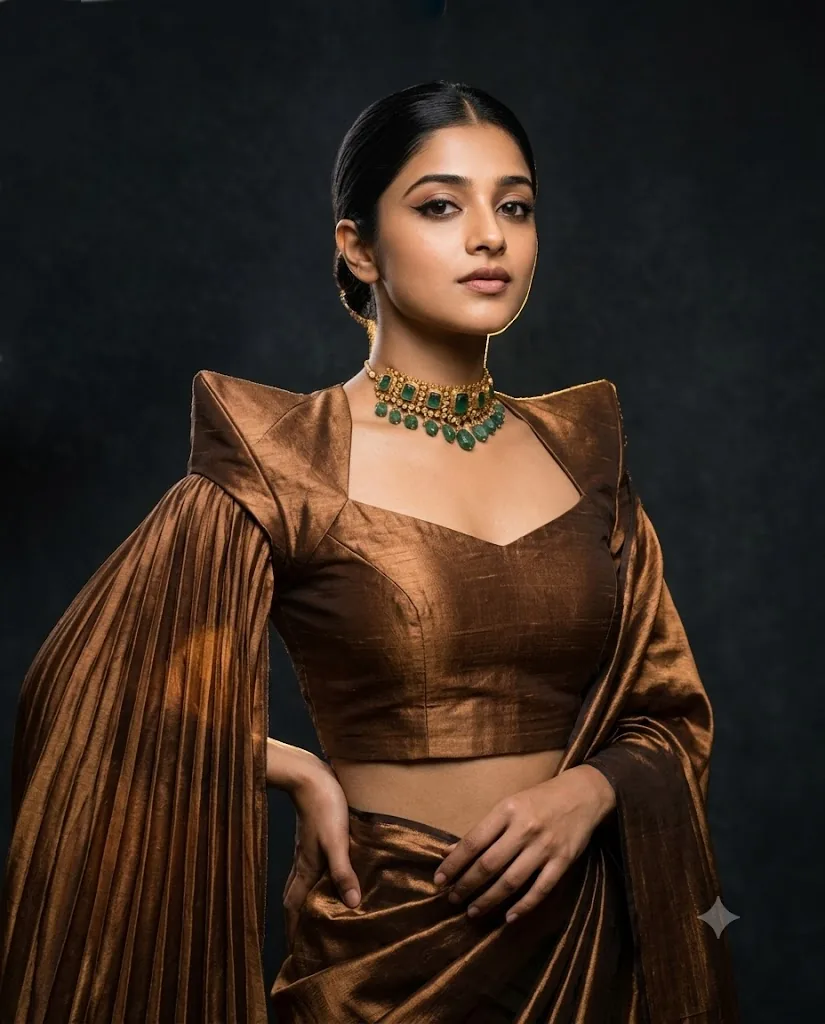
Best for: Designer lookbooks, luxury jewelry campaigns, modern ethnic wear.
Prompt:
Generate a high-fashion editorial portrait of a woman wearing an architectural metallic bronze silk ensemble against a deep charcoal textured background.

Subject & Styling: Confident high-fashion poise. Structured metallic silk blouse with sharp geometric shoulders and flowing pleated sleeves. Adorned with handcrafted matte-gold choker jewelry set with raw emerald stones. Minimalist sleek hair bun and refined winged eyeliner.

Lighting & Cinematography: Dramatic commercial studio lighting setup. A strong, narrow rim light positioned directly behind the subject outlines her shoulders and fabric edges in radiant gold. A large, diffused front-fill octabox maintains soft, gentle exposure across her face with subtle catchlights.

Optics & Finish: Shot on a 105mm macro portrait lens at f/3.2. Tack-sharp focus across jewelry facets and fine silk threads. Editorial film color grade, deep velvet blacks, rich midtones, aspect ratio 4:5.
- Why this Gemini photo prompt works: Using a 105mm lens at f/3.2 provides adequate depth of field to keep both facial features and intricate jewelry sharp, while the backlighting creates dramatic edge separation.
Comparing Engines for Cinematic Prompts
| Feature | Google Gemini | ChatGPT (Vision Engine) | Midjourney (v7 / v6) |
| Handling Lighting Directives | Excels at soft daylight falloff, directional window light, and subtle ambient bounce. | High contrast by default. Responds accurately to explicit fill-light, rim-light, and exposure commands. | Outstanding natural volumetric haze, cinematic bloom, and rich chiaroscuro shadows by default. |
| Optical Realism & Bokeh | Renders realistic optical depth of field and soft background compression without edge artifacts. | Delivers high edge-to-edge sharpness. Requires explicit f-stop and focal length prompts for shallow focus. | Best-in-class analog lens emulation, physical glass flare, and realistic spherical bokeh balls. |
| Material Textures | Outstanding rendering of organic materials, weave textures (cotton, linen, silk), and realistic skin specularity. | Accurate garment silhouettes and clean geometry. Benefits from color-timing terms to avoid saturation spikes. | Exceptional surface micro-textures on weathered leather, aged wood, chrome, and architectural surfaces. |
| Prompt Syntax & Structure | Best with natural descriptive paragraphs detailing subject, lighting geometry, and camera optics. | Best with structured, concise photographic directions that specify framing, wardrobe, and practical lights. | Best with complete descriptive sentences rather than comma-separated tag lists. Use parameter flags (--ar, --style raw) for formatting. |
4 Rules to Keep Your AI Photos Looking Real
- Name the light source: Never leave lighting to chance. State exactly where light enters the frame, whether that is a low-angle window to the left, direct golden-hour backlighting, or a practical tungsten desk lamp.
- Specify physical optical values: Replace vague terms like “close-up” or “detailed portrait” with concrete camera numbers such as “85mm at f/2.0” or “35mm at f/2.8” to govern depth falloff and spatial perspective.
- Drop legacy quality tags: Avoid stacking tokens like “photorealistic,” “8K,” “octane render,” or “masterpiece.” Modern engines associate these words with synthetic digital 3D art and over-sharpened HDR tone mapping.
- Embrace organic imperfections: Direct the model toward tactile reality by requesting subtle details like “airborne dust particles,” “natural fabric weave,” “gentle rain streaks,” or “stray wisps of hair.” Micro-imperfections convince the viewer that a scene was captured, not generated.
Discover More Cinematic Prompts
Cinematic AI photography comes down to optical precision and deliberate scene construction. By structuring your prompt like a director of photography, you can consistently bypass digital tropes and generate authentic film stills.
Explore our curated prompt collections to find tested blueprints for your next generation:
- Visit the South Prompts Homepage to view daily prompt releases.
- Explore the Cinematic Photography Collection for dramatic lighting and travel setups.
- Browse the People & Portraits Collection for candid lifestyle and character portraits.