
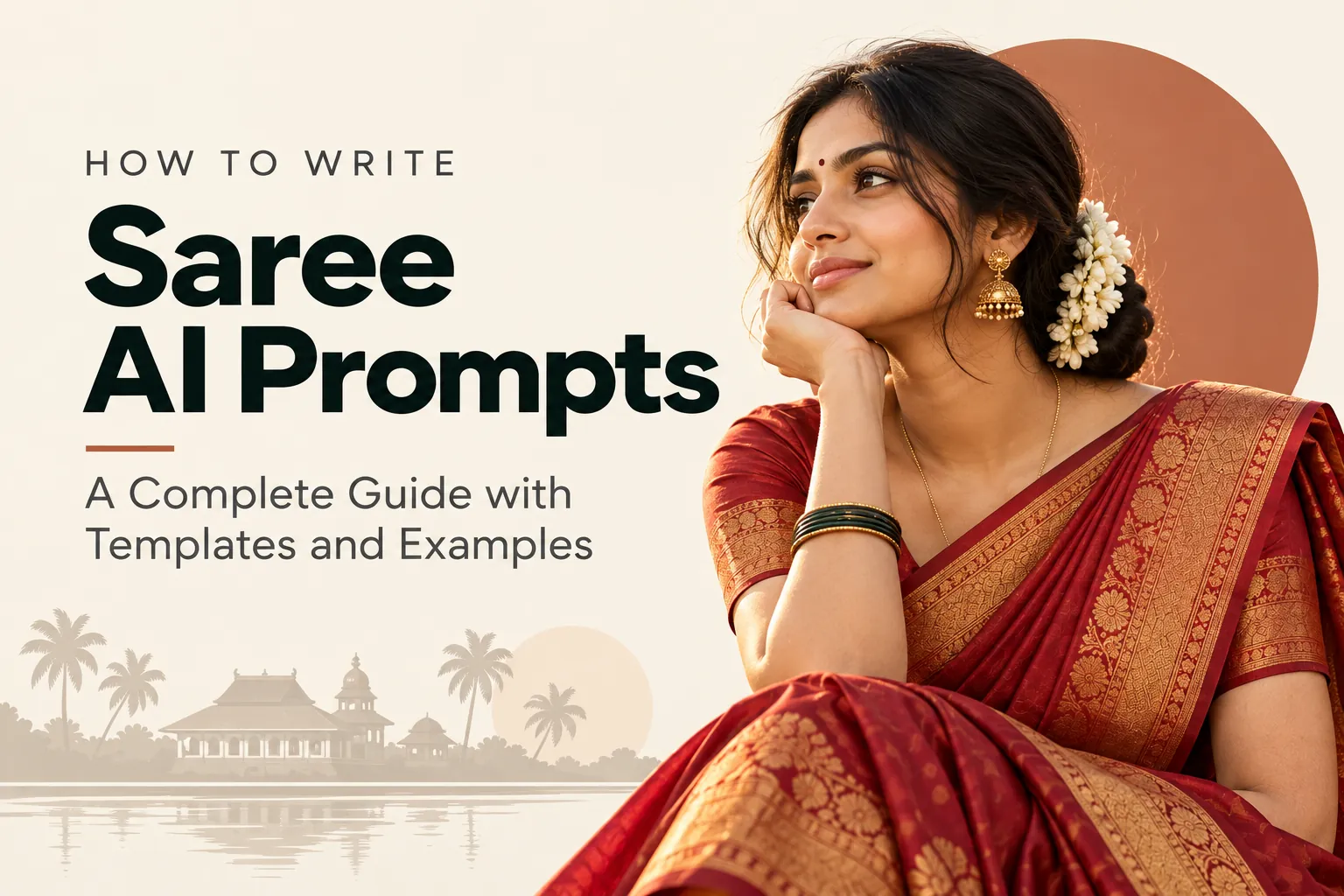
Generating a convincing saree portrait in an AI image generator often feels like a gamble. One generation gives you plastic skin and a distorted blouse. The next renders a saree that looks stamped onto the subject rather than draped around her body. The pleats blur together, the pallu hangs without weight, and the gold zari turns into neon yellow paint.
These issues happen because image generators treat vague prompts with generic assumptions. When you type “Indian woman in traditional saree”, the engine pulls from thousands of over-saturated stock photos.
Realism requires structural direction. You must tell the model what fabric is being worn, how that fabric behaves under gravity, and how real camera lenses capture fine weave textures.
This comprehensive guide breaks down the anatomy of an effective saree AI prompt. It includes tested prompt templates for Google Gemini, ChatGPT, and Midjourney, complete with fabric formulas and camera settings you can copy and use immediately.
Why Most Saree AI Prompts Fail
AI models do not understand cultural clothing by name alone. They respond to physical and optical attributes. Most failed outputs suffer from three basic mistakes:
- Missing Drape Mechanics: A saree is six to nine yards of unstitched cloth. It creates distinct structural elements: waist pleats (patli), a pleated or flowing shoulder drape (pallu), and a snug-fitting blouse. If you do not describe how the pallu falls, the AI will melt it into the background or turn it into a cape.
- Generic Fabric Labels: Words like “traditional dress” or “saree” produce flat synthetic textures. Words like “heavy mulberry silk,” “crisp unbleached cotton”, or “translucent organza” tell the model how the cloth reflects light and folds.
- Over-Processing Buzzwords: Prompts filled with “hyperrealistic”, “8k”, and “masterpiece” force the model to apply heavy sharpening and smoothing filters. This strips away natural skin pores and fabric thread definition.
The 4-Part Saree Prompt Formula
To get consistent results, structure your prompt into four logical blocks:
[Identity & Facial Integrity]
+ [Textile Specifications & Drape Physics]
+ [Blouse, Jewelry & Styling Details]
+ [Camera Optics, Lighting & Background]
1. Identity Lock
When using reference photos in Gemini or ChatGPT, start with an explicit identity command:
“Preserve exact facial structure, eye shape, natural skin tone, and expression from the reference image. Do not airbrush, beautify, or alter facial proportions.”
2. Textile and Drape Logic
Name the specific regional weave and describe its physical behavior:
- Kanjivaram / Banarasi Silk: Stiff, structured folds, heavy drape, matte woven zari border.
- Kerala Kasavu: Lightweight unbleached off-white cotton-silk, crisp pressed pleats, dull gold border.
- Organza / Chiffon: Translucent, airy volume, soft translucent layers, gentle breeze movement.
- Chanderi / Tussar: Earthy texture, subtle natural sheen, visible handloom slub threads.
3. Blouse and Ornamentation
Give the blouse a distinct neckline and sleeve cut to prevent the AI from guessing:
- Cuts: Elbow-length sleeves with gold piping, sleeveless with a clean square neckline, or classic round neck.
- Jewelry: Specify finishes such as antique matte temple gold, oxidized tribal silver, or uncut polki stones. This avoids overly glossy, fake-looking gold.
4. Photographic Settings
Anchor the render using real lens physics:
- Lenses: 85mm prime lens for flattering portrait compression; 50mm for three-quarter and full-length portraits.
- Aperture: f/1.8 to f/2.2 for creamy background separation; f/2.8 to f/4.0 if you want intricate zari borders and jewelry kept tack-sharp.
- Aspect Ratio: Always specify
4:5or9:16for vertical editorial framing.
5 Tested Saree Prompts You Can Copy and Paste
These prompts are engineered and tested based on the frameworks developed at South Prompts. You can adapt them to your own reference photos.
1. The Classic Crimson Kanjivaram Silk Portrait
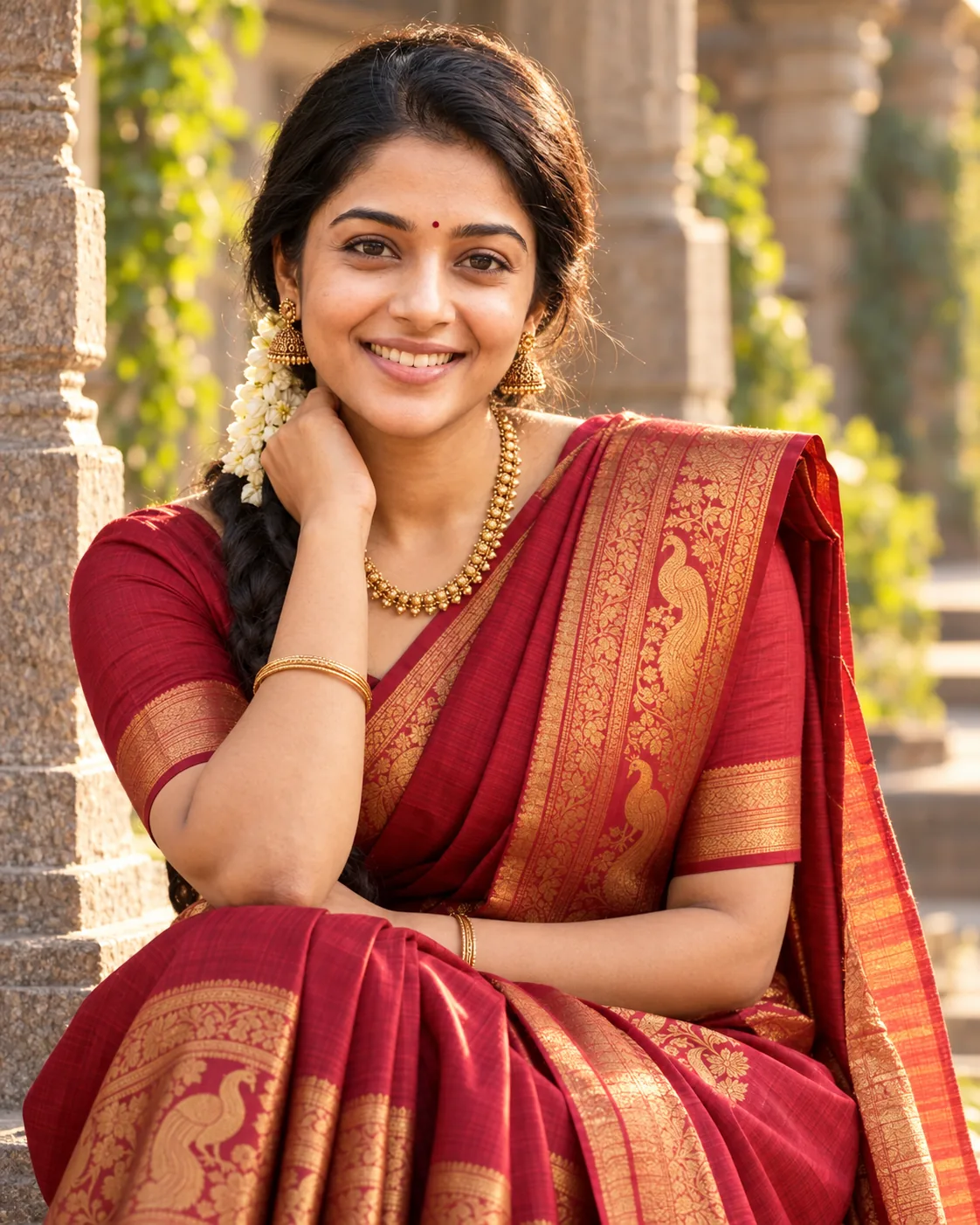
Best for: Bridal lookbooks, festive portraits, traditional South Indian aesthetics.
Prompt:
Cinematic medium-close portrait of a young South Asian woman wearing a traditional Kanjivaram silk saree.

Identity Lock: Retain exact facial features, natural warm skin undertones, dark eyes, and relaxed natural smile from the reference photo. Do not beautify, alter bone structure, or smooth skin texture.

Attire & Drape: She wears a rich crimson-red Kanjivaram silk saree with an authentic woven gold zari border featuring delicate peacock motifs. The silk fabric has structured, crisp pleats with a natural heavy drape. The pallu is neatly pinned over her left shoulder, falling gracefully. She pairs it with a matching crimson elbow-length blouse with subtle gold piping along the sleeves.

Jewelry & Styling: Traditional antique matte gold jhumka earrings, a single delicate mango mala necklace, thin gold bangles, and a tiny round red bindi on her forehead. Hair is styled in a neat braid adorned with fresh white jasmine flowers.

Setting & Optics: Outdoors in a sunlit heritage courtyard with stone pillars and climbing green vines softly blurred in the distance. Shot on an 85mm lens at f/2.2. Soft golden hour light illuminates her profile with natural rim highlights. Visible skin pores, sharp fabric weave detail, rich color grading, vertical aspect ratio 4:5.
- Why it works: Naming the weight of the silk and specifying “pinned pallu” eliminates awkward fabric floating. Setting the aperture to f/2.2 preserves the fine details of the mango mala necklace. See similar compositions in the South Prompts Sarees Collection.
2. Modern Ivory Silk Organza Editorial
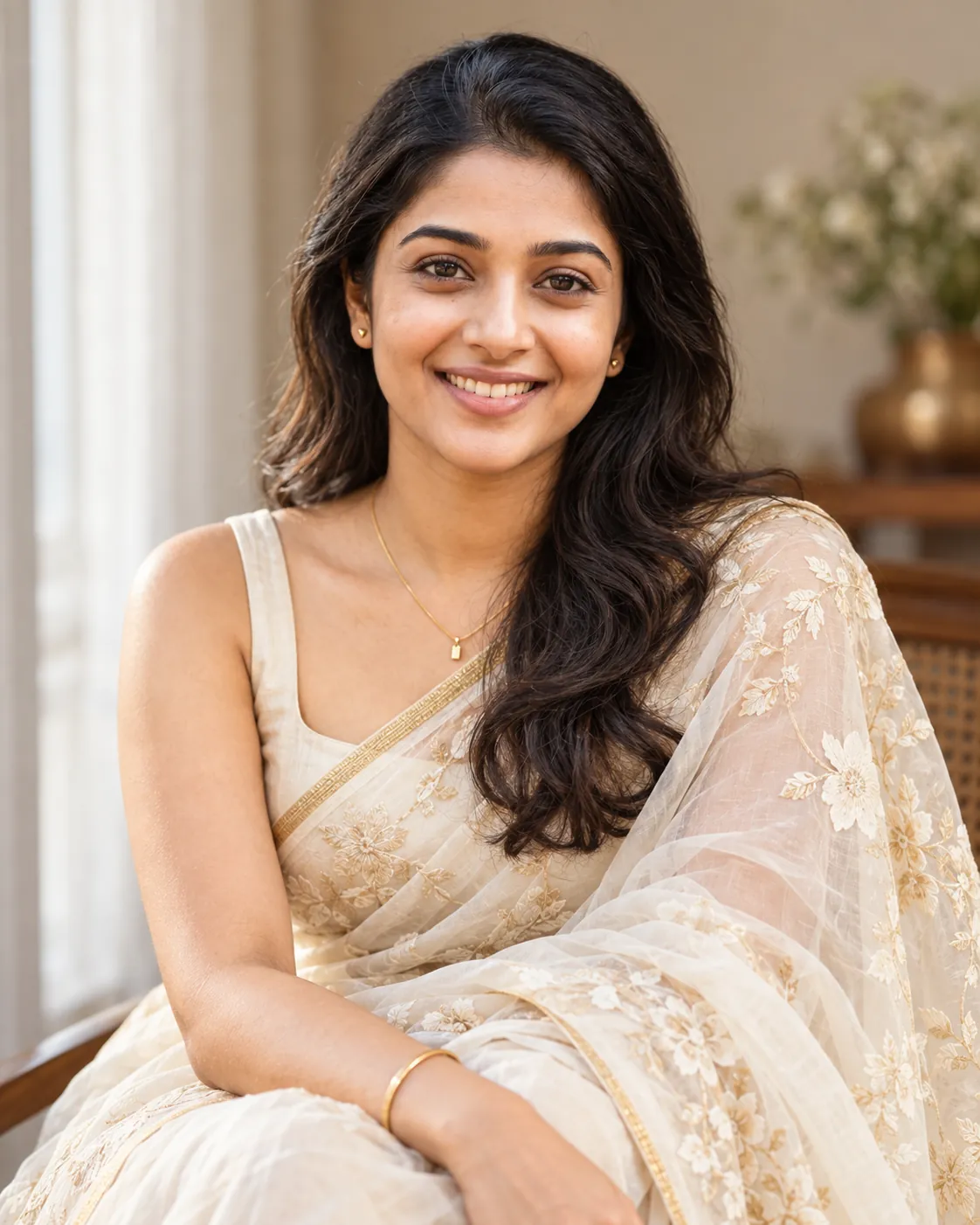
Best for: Clean studio aesthetics, high-end profile pictures, minimalist fashion.
Prompt:
Photorealistic editorial portrait of a woman wearing an ivory silk organza saree in soft indoor daylight.

Identity Lock: Use the uploaded image as strict facial reference. Maintain natural bone structure, eye shape, and gentle expression without AI stylization.

Attire & Drape: An elegant, lightweight ivory organza saree featuring hand-embroidered floral threadwork and a thin antique gold border. The translucent fabric shows delicate translucent layering around the shoulder drape, floating naturally with soft volume. Paired with a tailored sleeveless raw silk blouse with a modest square neckline.

Jewelry & Styling: Contemporary minimalist styling. Delicate gold stud earrings, a slender gold chain necklace with a small geometric pendant, and a thin gold bangle. Her dark wavy hair is left open over one shoulder. Soft, natural makeup with matte nude lips.

Setting & Optics: Indoor photography studio beside a large window. Soft, diffused directional daylight creates smooth facial gradients and subtle catchlights in her eyes. Neutral warm background softly out of focus. Shot on an 85mm f/1.8 lens. High resolution, authentic skin texture, realistic textile micro-fibers, vertical aspect ratio 4:5.
- Why it works: Based on the approach in the Photorealistic Gemini Silk Saree Editorial Portrait, this prompt pairs lightweight organza with directional window lighting to capture authentic translucency.
3. Kerala Kasavu Saree Backwater Portrait
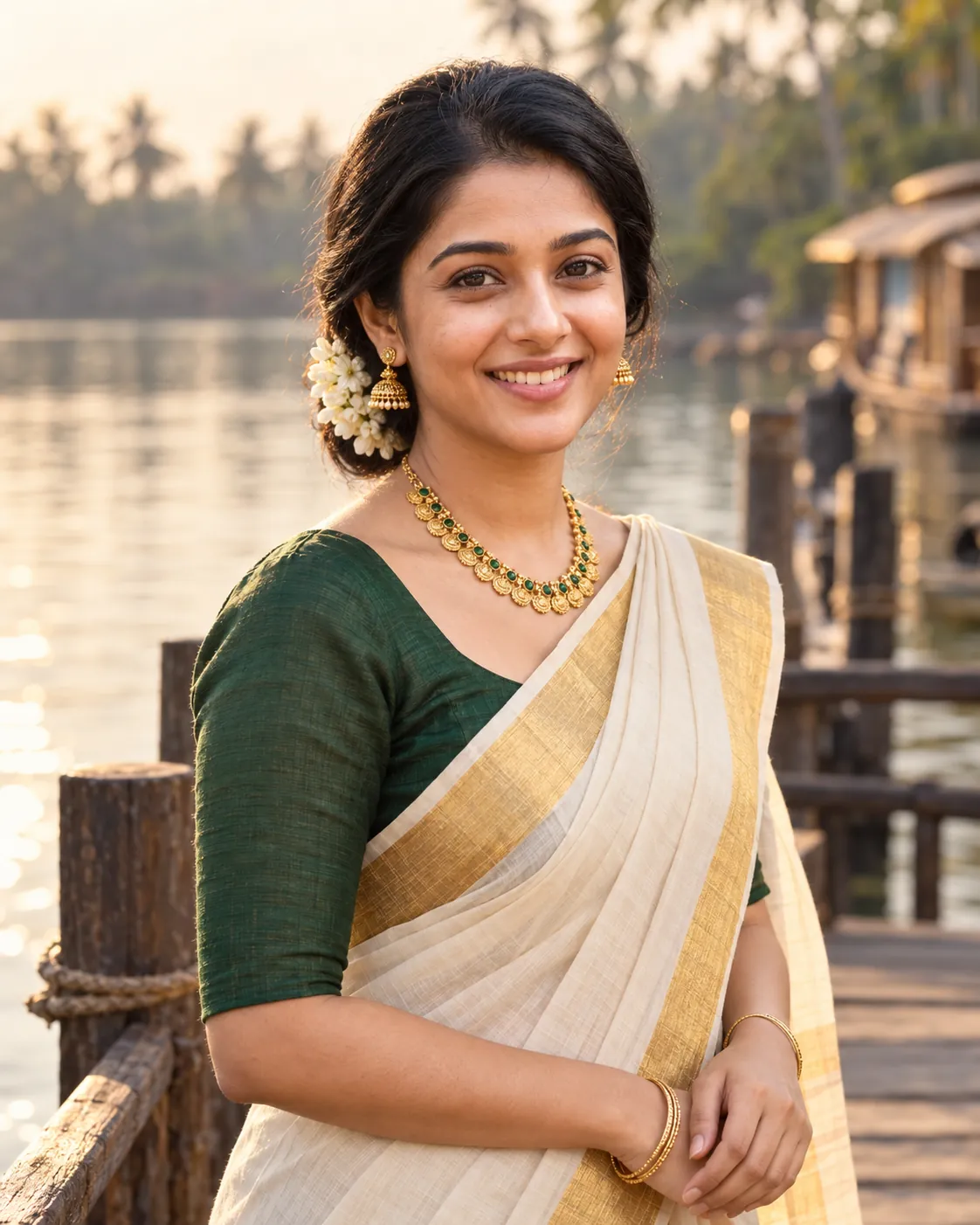
Best for: Onam celebrations, serene outdoor travel shoots, cultural branding.
Prompt:
Candid three-quarter portrait of a young South Asian woman wearing an authentic Kerala Kasavu saree beside calm waters.

Identity Lock: Faithfully match the reference image facial proportions, skin tone, and gentle expression. Ensure natural, unedited facial anatomy.

Attire & Drape: An authentic unbleached off-white cotton Kasavu saree featuring a crisp 3-inch woven dull-gold zari border. The handloom cotton fabric has a clean, tactile texture with natural fold lines. Paired with a contrast bottle-green raw silk blouse with elbow-length sleeves.

Jewelry & Styling: Traditional Kerala temple ornaments: a gold palakka necklace with green stones, classic gold jimikki earrings, and thin gold bangles. Her hair is loosely gathered into a low bun decorated with a ring of fresh mullappoo (jasmine).

Setting & Optics: Standing near a rustic wooden pier along the Kerala backwaters during late afternoon. Gentle water reflections and distant palm tree silhouettes create a calm background. Shot on a 50mm prime lens at f/2.0. Warm, humid atmospheric light with gentle side illumination. Realistic fabric weave, lifelike skin pores, natural shadows, aspect ratio 4:5.
- Why it works: Specifying “unbleached off-white cotton” stops the engine from generating bright, synthetic white polyester. Similar prompts can be found under the Onam Saree Portrait tag.
4. Candid Plum Purple Saree Sunset Portrait
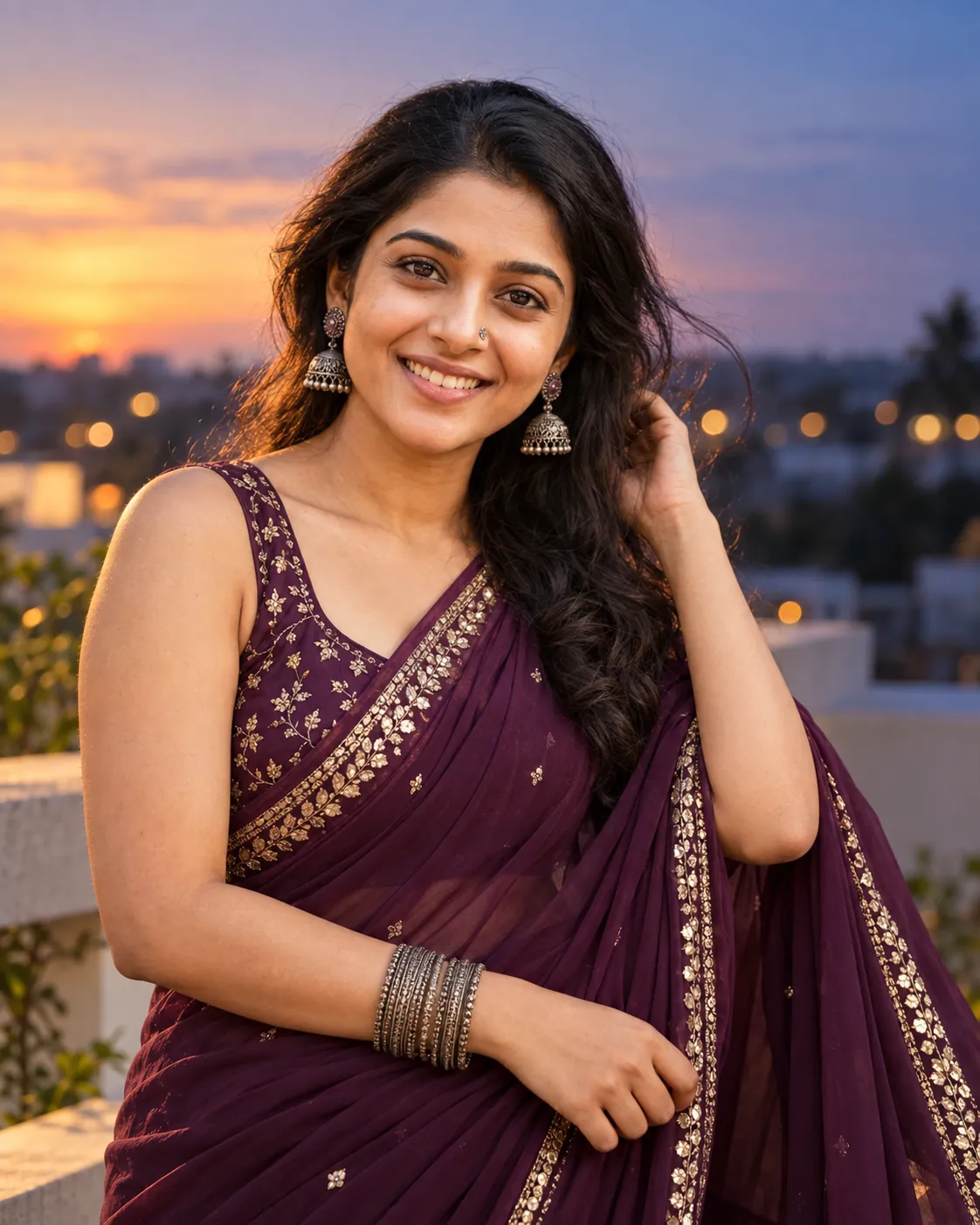
Best for: Evening functions, mood boards, romantic outdoor portraits.
Prompt:
Candid outdoor portrait of a smiling South Asian woman in a plum purple georgette saree at twilight.

Identity Lock: Preserve facial structure, natural warm skin complexion, and authentic eye smile from the provided image. Avoid airbrushing or cosmetic alterations.

Attire & Drape: A flowing deep plum purple georgette saree with fine gota-patti border work that catches the evening light. The fluid fabric drapes softly around her torso, with the pallu casually draped over her forearm as if caught mid-movement. Paired with a matching plum sleeveless blouse with delicate gold embroidery.

Jewelry & Styling: Oxidized silver statement earrings with small bells, stacked oxidized bangles, and a delicate silver nose pin. Open, wind-tousled hair with soft natural curls.

Setting & Optics: Shot on an open terrace with warm sunset tones fading into deep twilight blue behind her. Distant warm bokeh lights add atmosphere. 85mm f/1.8 lens setup. Low-light exposure balanced with soft ambient illumination, preserving deep shadows without digital noise. Film-like grain, authentic textile texture, aspect ratio 4:5.
- Why it works: Specifying georgette gives the garment a soft, fluid drape. The combination of oxidized silver with deep plum purple prevents the color clipping that often occurs with bright red and gold prompts. This follows the style of the Candid Plum Purple Saree Portrait.
5. Festive Half Saree (Langa Voni) Portrait
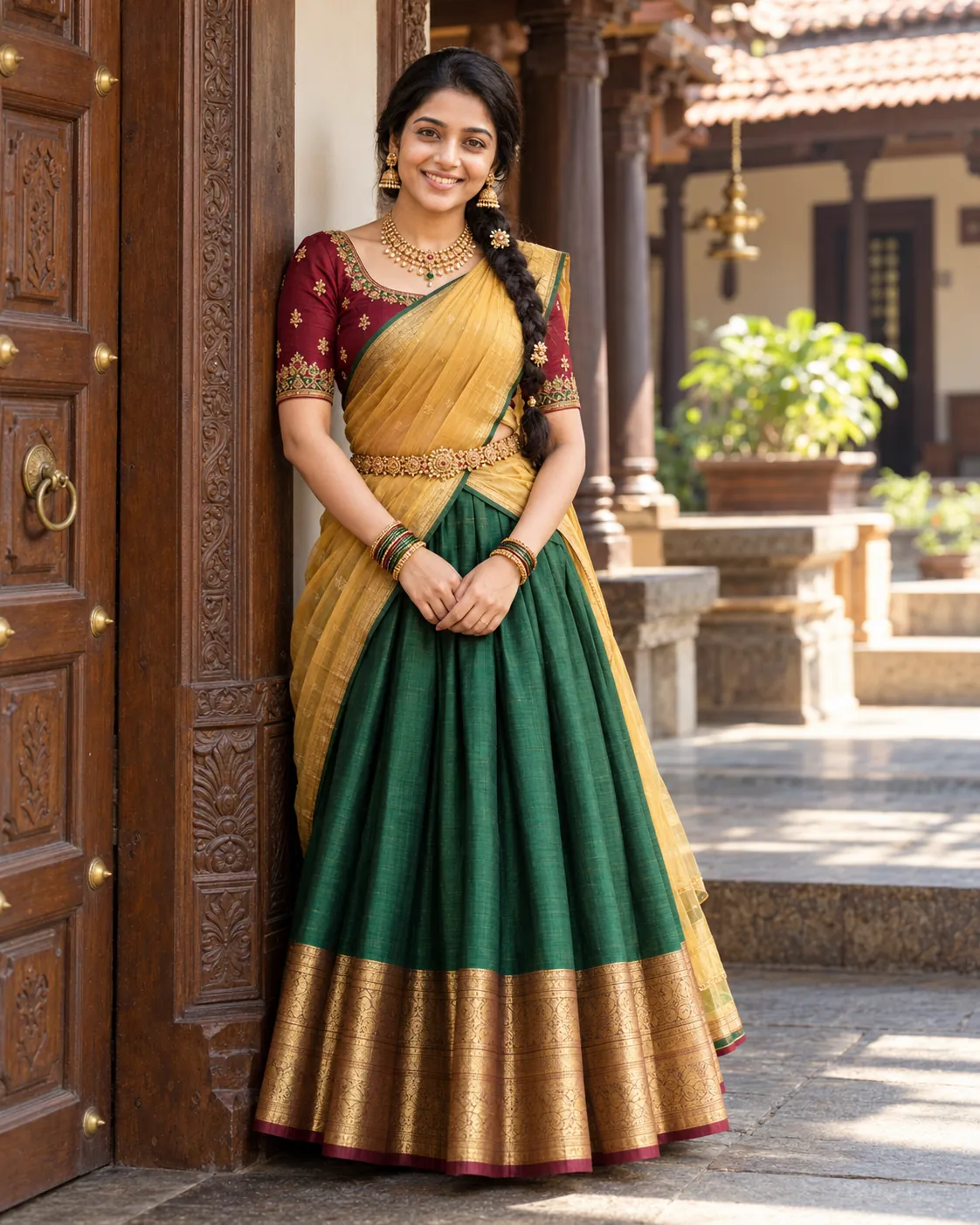
Best for: Traditional South Indian festivities, vibrant youth portraits, milestone birthdays.
Prompt:
Candid full-body portrait of a young South Asian woman wearing a traditional South Indian half saree (pattu pavada dhavani).

Identity Lock: Match the face from the reference picture with complete fidelity in proportions, skin undertone, and smile.

Attire & Drape: An emerald-green silk flared skirt with a wide golden zari border, paired with an embroidered maroon blouse and a sheer golden-yellow tissue dhavani (dupatta) neatly pleated and draped diagonally across the torso and tucked at the waist. The silk skirt shows rich volume and crisp pleating.

Jewelry & Styling: Antique gold waist belt (vaddanam/oddiyanam), layered guttapusalu necklace, large traditional jhumkas, and matching bangles. Hair arranged in a long braid with hair ornaments.

Setting & Optics: Standing beside an ornate carved wooden doorway of an ancestral home. Soft directional morning light entering through an open veranda roof. Shot on a 50mm portrait lens at f/2.8 to maintain sharpness across the entire outfit from head to toe. Crisp fabric weave, rich shadows, warm natural tones, aspect ratio 4:5.
- Why it works: A half saree has three distinct garments. Explicitly defining the skirt, blouse, and pleated dhavani prevents the model from combining them into an ambiguous gown. Explore more references on the South Prompts Half Saree Directory.
Model Differences: Gemini vs. ChatGPT for Saree Generation
| Feature | Google Gemini (Imagen 3) | ChatGPT (DALL-E 3) |
| Facial Likeness | Best in class. Maps uploaded reference faces onto complex traditional outfits without distortion. | Good, but tends to alter bone structure unless strictly told to avoid stylization. |
| Zari & Metallic Texture | Excels at matte, antique, and beaten gold finishes. Rarely over-saturates. | Can produce exaggerated, reflective yellow gold if not specified as “dull gold” or “matte.” |
| Complex Drape Logic | Follows multi-step textile instructions cleanly. Preserves pleat structure. | Translates conversational style well, but may simplify intricate border patterns. |
| Prompt Length | Handles detailed 150 to 250 word prompts with high fidelity across all clauses. | Best kept around 100 to 150 words to avoid prompt truncation or random substitutions. |
4 Pro Tips for Perfect Saree Generations
- Control the Gold Finish: The word “gold” alone often yields shiny metallic yellow. Always qualify it: use “antique matte gold,” “dull copper zari,” or “brushed antique brass.”
- Specify Blouse Sleeve Length: If you leave the blouse unspecified, AI often creates incongruous, generic tops. Specify “elbow-length sleeves with zari border” or “sleeveless with clean piping.”
- Adjust Aperture for Jewelry: An ultra-fast aperture like f/1.4 looks cinematic, but it can blur the intricate carvings on earrings and necklaces. Use f/2.5 to f/3.5 when jewelry is a primary focal point.
- Use Fabric Tension Words: Include words like “crisp pressed pleats,” “flowing fluid drape,” or “structured heavy silk.” These provide the model with physical clues for rendering realistic fabric folds.
Explore More Tested Prompts
Mastering the saree prompt comes down to clear textile and optical direction. Once you master the four-layer structure, you can generate authentic portraits across any regional style or color palette.
To browse and copy hundreds of tested, ready-to-use AI prompts:
- Visit the South Prompts Homepage for daily additions.
- Browse the full Sarees Collection for Kanjivaram, Kasavu, Banarasi, and Organza prompts.
- Explore the Traditional Looks Collection for festival styling, half sarees, and cultural aesthetics.